
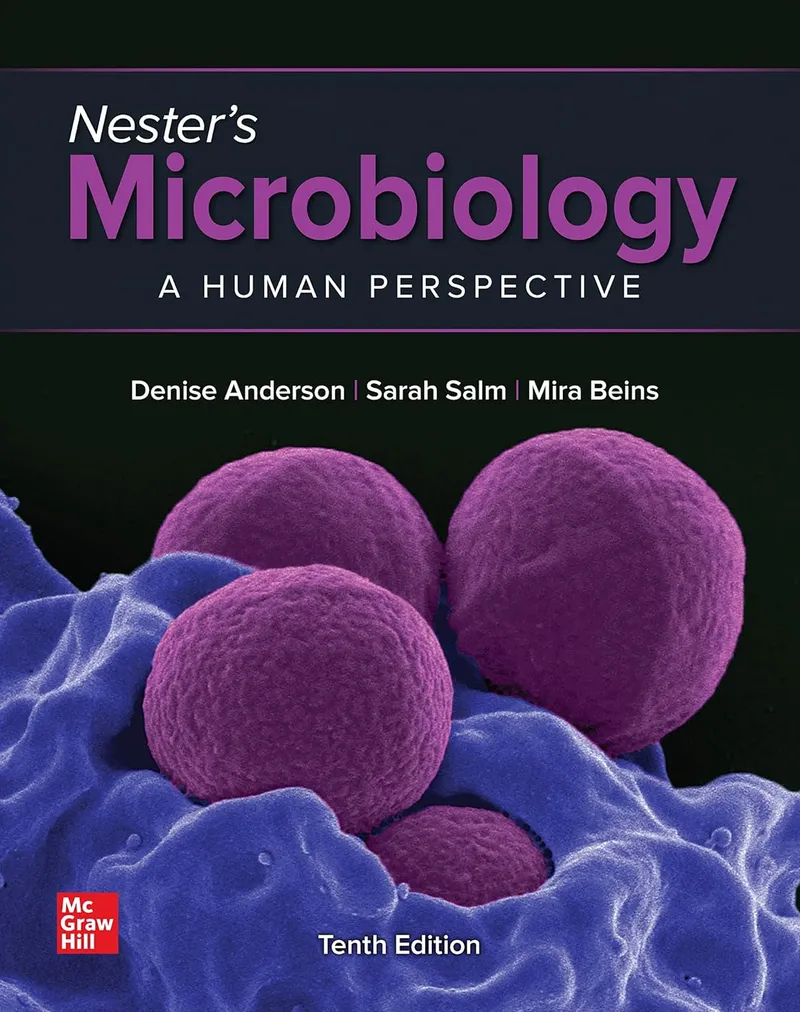

Nester’s Microbiology: A Human Perspective, 10th Edition
Nester’s Microbiology: A Human Perspective, 10th Edition is a comprehensive introductory microbiology textbook that presents the science of microorganisms through a strong connection to human health, disease, and everyday life. Published by McGraw Hill, the 10th edition is designed especially for students who need a solid understanding of microbiology without necessarily specializing in the subject. It is particularly appropriate for non-majors, allied-health students, and mixed-major courses. McGraw Hill describes the text as concise and readable, with clear explanations of fundamental concepts and a body-systems approach to infectious diseases.
Rather than treating microbiology as a long list of microorganisms and terminology, Nester’s Microbiology: A Human Perspective helps students understand how microorganisms interact with humans and the environment. The book moves from the basic chemistry and cellular biology of microorganisms to microbial genetics, biotechnology, immunology, infectious diseases, antimicrobial medications, microbial ecology, environmental microbiology, and food microbiology.
About Nester’s Microbiology: A Human Perspective
Microorganisms are present virtually everywhere. They live in soil, water, food, animals, and the human body, and they can have effects ranging from beneficial and essential to harmful and life-threatening. Understanding microbiology therefore requires more than learning the names of bacteria, viruses, fungi, and parasites. Students need to understand how microorganisms grow, reproduce, exchange genetic information, interact with their hosts, cause disease, and respond to environmental conditions.
Nester’s Microbiology: A Human Perspective approaches these subjects from a human-centered perspective. Fundamental microbiological concepts are introduced before the discussion moves toward microorganisms and humans, immune responses, infectious diseases, and applied microbiology.
This organization can make the subject easier to approach for students who are encountering microbiology for the first time.
A Human Perspective on Microbiology
One of the defining characteristics of the book is its emphasis on the relationship between microorganisms and people.
Microbiology is closely connected with medicine, nursing, public health, nutrition, biotechnology, environmental science, and many other fields. By presenting microbial concepts alongside their relevance to human health, the textbook helps students see why subjects such as microbial growth, bacterial genetics, immune responses, and antimicrobial drugs matter outside the laboratory.
The disease material is organized using a body-systems approach, allowing infectious diseases to be considered in relation to the respiratory system, skin, wounds, digestive system, blood and lymphatic system, nervous system, and genitourinary tract. McGraw Hill highlights this body-systems approach as one of the text’s distinguishing features.
What Does Nester’s Microbiology 10th Edition Cover?
The 10th Edition is organized into five broad parts covering the foundations of microbiology, the microbial world, microorganisms and humans, infectious diseases, and applied microbiology.
Humans and the Microbial World
The book begins by introducing the relationship between humans and microorganisms. This provides a useful starting point for understanding why microbiology is important and how microorganisms influence health, disease, ecosystems, and society.
Students are introduced to the microbial world and the role microorganisms play in human life before moving into the chemical and cellular foundations required for more advanced microbiological concepts.
The Molecules of Life
Understanding microorganisms requires a basic knowledge of biological chemistry. The text introduces the molecules that make up living systems and explains their importance to microbial structure and function.
These foundations become important when students later study microbial metabolism, DNA replication, gene expression, cellular structures, and other processes.
Cells and Methods to Observe Them
Microorganisms display enormous diversity in their cellular structures. This section introduces cells and the techniques used to observe them, giving students the background necessary to distinguish different types of microbial life.
Laboratory observation is fundamental to microbiology because microorganisms cannot always be studied directly with the naked eye. Microscopy and related techniques allow researchers and laboratory professionals to investigate cellular morphology and microbial characteristics.
Dynamics of Microbial Growth
Microbial growth is central to understanding both beneficial and harmful microorganisms. Students learn how microbial populations grow and how environmental conditions influence their development.
These principles have practical applications in clinical microbiology, food microbiology, biotechnology, and laboratory culture techniques.
Control of Microbial Growth
The ability to control microorganisms is essential in healthcare, food production, laboratory work, and public health.
The textbook examines principles involved in controlling microbial populations and provides the conceptual background needed to understand methods used to reduce or eliminate microorganisms.
Microbial Metabolism
Microbial metabolism explains how microorganisms obtain energy and construct the components required for cellular growth.
Because microorganisms possess a remarkable range of metabolic strategies, this subject also helps explain their ability to survive in diverse environments. Understanding metabolism provides a foundation for studying microbial ecology, biotechnology, and microbial physiology.
From DNA to Protein
Genetic information provides the instructions that allow cells to produce proteins and regulate their activities. The book introduces the flow of genetic information from DNA to RNA and proteins and explains why these processes are fundamental to microbial biology.
This material prepares students for later discussions of bacterial genetics, biotechnology, mutation, and microbial adaptation.
Bacterial Genetics
Bacterial genetics explores how bacteria maintain, express, and exchange genetic information.
This is an especially important area of microbiology because genetic variation can influence microbial characteristics, adaptation, pathogenicity, and resistance to antimicrobial drugs.
Biotechnology
The textbook introduces biotechnology as an application of microbiological and molecular biological principles.
Students can see how microorganisms and their genetic systems can be used as tools in scientific research, medicine, industry, and other areas of biotechnology.
Exploring the Microbial World
The second major part of the book focuses more directly on microbial diversity and classification.
Identifying and Classifying Microorganisms
Microorganisms must be identified and classified using a variety of characteristics and analytical approaches. The book introduces the principles involved in microbial identification and classification.
These techniques are important in both research and clinical settings, where correctly identifying a microorganism can be essential for understanding its characteristics or selecting an appropriate treatment strategy.
Bacteria and Archaea
Bacteria and archaea represent two major groups of prokaryotic life. The book explores their diversity and biological characteristics, helping students understand the enormous variety that exists within the microbial world.
Eukaryotic Microorganisms
Not all microorganisms are prokaryotes. The text also examines eukaryotic members of the microbial world, broadening students’ understanding of microscopic life.
This includes organisms with fundamentally different cellular structures and biological characteristics from bacteria and archaea.
Viruses, Viroids, and Prions
The book also introduces infectious agents that differ from cellular microorganisms.
Viruses, viroids, and prions have distinctive biological characteristics and require different approaches to study and control. Understanding these agents is particularly important for students interested in medical microbiology and infectious disease.
Microorganisms and Humans
A major strength of Nester’s Microbiology is its detailed consideration of interactions between microorganisms and humans.
Innate and Adaptive Immunity
The immune system provides the body with multiple mechanisms for recognizing and responding to microorganisms.
The textbook introduces both innate immunity and adaptive immunity, allowing students to understand the differences between the body’s immediate defenses and the more specialized responses that develop after exposure to particular antigens.
Host–Microbe Interactions
Humans constantly interact with microorganisms. Some microbial relationships are harmless or beneficial, while others can result in infection and disease.
The study of host–microbe interactions helps explain colonization, infection, microbial virulence, and the factors that determine whether exposure to a microorganism results in disease.
Applications of Immune Responses
Immunology has many practical applications in medicine and public health. The book explores how knowledge of immune responses can be applied to human health.
This provides a useful connection between fundamental immunology and practical healthcare applications.
Immunological Disorders
The immune system must be carefully regulated. When immune responses are abnormal, they can contribute to disease.
The text therefore considers disorders involving immunity and helps students understand that the immune system can itself become a source of pathology when its responses are inappropriate or dysfunctional.
Epidemiology
Understanding infectious disease requires more than studying individual pathogens. Epidemiology examines how diseases occur and spread within populations.
Students are introduced to concepts that help explain patterns of infection and the factors that influence the transmission of infectious diseases.
Antimicrobial Medications
Antimicrobial medications are among the most important practical applications of microbiology.
The textbook examines antimicrobial therapy and the relationship between microorganisms and antimicrobial drugs. This material is particularly relevant to healthcare students because successful treatment of infectious disease depends on understanding both the pathogen and the properties of the antimicrobial agent.
Infectious Diseases by Body System
The 10th Edition uses a body-systems approach when discussing infectious diseases. This organization allows students to connect individual pathogens with the anatomical systems and tissues they affect.
The infectious-disease section includes topics involving:
- Respiratory system infections
- Skin infections
- Wound infections
- Digestive system infections
- Blood and lymphatic infections
- Nervous system infections
- Genitourinary tract infections
This approach can be particularly useful for students in nursing, allied health, medical laboratory science, and other health-related programs because it connects microbiology with the anatomy and physiology they encounter elsewhere in their studies.
Applied Microbiology
The final part of the textbook moves beyond clinical microbiology and explores the broader applications of microorganisms.
Microbial Ecology
Microorganisms are essential components of ecosystems. They participate in nutrient cycling, decomposition, symbiotic relationships, and many other ecological processes.
Microbial ecology helps students understand that microorganisms are not simply disease-causing agents. They are fundamental to the functioning of natural environments.
Environmental Microbiology
Environmental microbiology examines the roles microorganisms play in processes such as water treatment, waste treatment, and the transformation of polluted environments.
This area demonstrates how microbiology can be applied to environmental problems and public health challenges.
Food Microbiology
Microorganisms have a complex relationship with food. They can contribute to fermentation and food production, but they can also cause spoilage and foodborne disease.
Food microbiology therefore provides an important connection between microbial growth, human health, food safety, and biotechnology.
Why Is Nester’s Microbiology Useful for Students?
Microbiology can be challenging because students are required to learn concepts from several areas of science at the same time. Cellular biology, chemistry, genetics, physiology, immunology, and epidemiology all contribute to understanding microorganisms and infectious diseases.
Nester’s Microbiology: A Human Perspective addresses this challenge through a clear progression from fundamental principles toward human and clinical applications.
McGraw Hill emphasizes the book’s concise and readable style, its focus on fundamental concepts, and its instructional artwork. The publisher also describes the text as suitable for non-major and allied-health students.
This makes the book particularly useful when students need to understand the underlying biology rather than simply memorize lists of microorganisms and diseases.
Who Is Nester’s Microbiology 10th Edition For?
The book can be useful for:
- Undergraduate microbiology students
- Biology students
- Nursing students
- Allied-health students
- Medical laboratory science students
- Health-science students
- Students taking microbiology for non-majors
- Students studying infectious diseases
- Students interested in immunology
- Students preparing for healthcare-related careers
- Independent learners interested in microbiology
It is especially well suited to courses where microbiology is being studied as part of a broader health-science curriculum rather than as a highly specialized microbiology program.
Connecting Microbiology with Everyday Life
One of the most valuable aspects of a human-centered microbiology textbook is the opportunity to connect scientific principles with experiences outside the classroom.
Questions about infection, vaccination, antimicrobial drugs, food safety, environmental contamination, antibiotic resistance, and the microorganisms that live on and inside the human body are all microbiological questions with direct relevance to everyday life.
By understanding the principles behind these subjects, students can develop a more informed view of health and disease and become better prepared to evaluate microbiological information encountered in academic, clinical, or public settings.
Final Thoughts
Nester’s Microbiology: A Human Perspective, 10th Edition provides a broad introduction to microbiology while maintaining a strong focus on the relationship between microorganisms and human health.
From the molecules and cells that form the foundation of microbial life to bacterial genetics, biotechnology, microbial diversity, viruses, immunity, infectious diseases, antimicrobial medications, epidemiology, and applied microbiology, the book covers the major concepts students need for an introductory understanding of the field.
Its human-centered organization makes the material particularly relevant to students in health-related programs. The body-systems approach to infectious diseases also helps bridge the gap between basic microbiological principles and the clinical situations in which those principles become important.
For students beginning a microbiology course, Nester’s Microbiology: A Human Perspective offers a structured way to explore the microbial world and understand why microorganisms matter in medicine, public health, the environment, food, and everyday human life.
Book Information
Title: Nester’s Microbiology: A Human Perspective
Edition: 10th Edition
Authors: Denise Anderson, Sarah Salm, Deborah Allen, Eugene W. Nester
Publisher: McGraw Hill Higher Education
Publication Year: 2022
Subject: Microbiology / Medical Microbiology / Allied Health
Print ISBN-13: 9781265062316
eText ISBN-13: 9781265003937
Support the Creators!
If you enjoy this book, please consider supporting the author and publisher by purchasing a physical or digital copy. Buying official copies ensures authors can keep writing great books.