
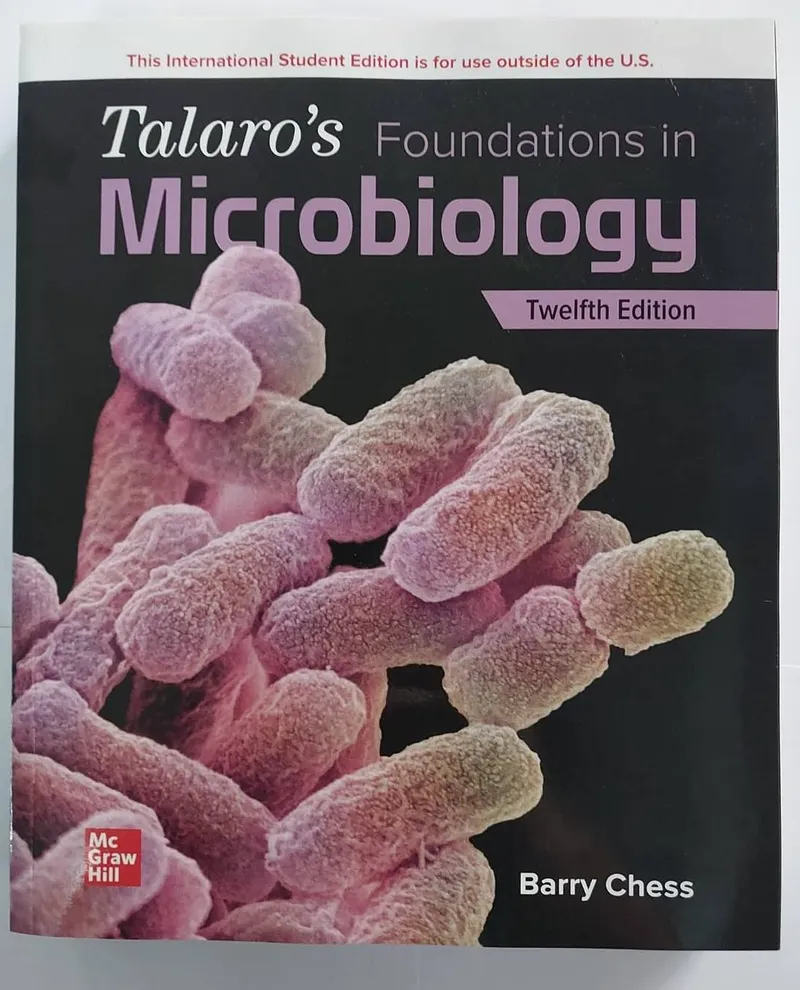

Talaro’s Foundations in Microbiology: Basic Principles, 12th Edition
Talaro’s Foundations in Microbiology: Basic Principles, 12th Edition by Barry Chess is a comprehensive introductory microbiology textbook that presents the fundamental principles of microbiology in a clear, accessible, and engaging way. Published by McGraw-Hill Higher Education, the book is particularly well suited to students in allied health and other life-science programs who need a strong foundation in microorganisms, microbial processes, infectious diseases, immunity, genetics, and laboratory methods.
Rather than presenting microbiology as a collection of unfamiliar terms and microscopic structures, the book gradually develops the concepts students need to understand how microorganisms live, grow, interact with their environments, and affect humans. Its use of case studies and analogies helps connect abstract microbiological concepts with situations that are easier to recognize and understand. McGraw-Hill specifically describes the text as using an engaging writing style and case studies and analogies to explain difficult microbiology concepts.
About Talaro’s Foundations in Microbiology: Basic Principles
Microbiology sits at the intersection of biology, chemistry, medicine, environmental science, and biotechnology. Understanding it requires students to move comfortably between very different scales—from atoms and chemical reactions to individual microbial cells, populations, infectious diseases, and interactions between microorganisms and their hosts.
- Talaro’s Foundations in Microbiology: Basic Principles* is structured to guide students through these levels in a logical progression. The early chapters establish the chemical and cellular foundations of microbiology before moving into microbial diversity, viruses, microbial growth and metabolism, genetics, microbial control, chemotherapy, infection, immunity, and the identification of pathogens.
The 12th Edition contains 17 chapters, beginning with the major themes of microbiology and ending with procedures used to identify pathogens and diagnose infections.
This organization makes the book useful for students who are encountering microbiology for the first time and need to develop an understanding of how the different areas of the discipline fit together.
What Does the 12th Edition Cover?
The book provides broad coverage of the core subjects normally encountered in an introductory microbiology course. Its chapters progress from the foundations of the discipline toward increasingly specialized topics involving microorganisms and human health.
The Main Themes of Microbiology
The opening chapter introduces the scope of microbiology and the many roles microorganisms play in the natural world and in human society. Students are introduced to the characteristics of microorganisms, their cellular organization, viruses and prions, microbial involvement in energy and nutrient cycles, infectious diseases, the history of microbiology, taxonomy, and microbial evolution.
This opening perspective is important because microorganisms are not limited to their role as disease-causing agents. They are also essential participants in ecosystems, nutrient cycling, biotechnology, and many processes that support life on Earth.
The Chemistry of Biology
A solid understanding of chemistry is essential for studying microorganisms. The second chapter introduces atoms, elements, chemical bonds, molecules, chemical reactions, solutions, and pH.
These principles provide the background needed to understand later topics such as microbial metabolism, enzyme activity, cellular structures, and the chemical mechanisms behind microbial growth.
Tools of the Laboratory
Microbiology depends heavily on laboratory techniques for observing, cultivating, identifying, and studying microorganisms. The book therefore introduces students to the tools and methods used to investigate microbial life.
Laboratory concepts are especially important for students preparing for health-related careers because the identification of microorganisms and interpretation of laboratory findings play an important role in diagnosing infectious diseases.
Prokaryotic Cells and Microorganisms
The book then examines prokaryotic microorganisms, including their cellular structures and characteristics. Students develop an understanding of the organisms commonly grouped among bacteria and archaea and the features that distinguish prokaryotic cells from other forms of life.
Learning how microbial cells are organized provides a foundation for understanding microbial nutrition, growth, metabolism, genetics, and susceptibility to antimicrobial agents.
Eukaryotic Cells and Microorganisms
The following chapter turns to eukaryotic microorganisms and their cellular organization. This broader perspective allows students to compare different types of microorganisms and appreciate the diversity of cellular structures found among microscopic life.
The distinction between prokaryotic and eukaryotic microorganisms is particularly important when studying organisms that cause human disease because their cellular characteristics influence their biology, diagnosis, and treatment.
Viruses, Viroids, and Prions
Microbiology also includes infectious agents that do not fit the traditional definition of a living cellular organism. The text introduces viruses, viroids, and prions and explains their basic characteristics and biological significance.
This section helps students understand why viruses differ fundamentally from bacterial and eukaryotic microorganisms and why viral infections require approaches to diagnosis and treatment that differ from those used for bacterial infections.
Microbial Nutrition, Ecology, and Growth
Microorganisms require nutrients and appropriate environmental conditions to grow and reproduce. The book examines microbial nutrition, microbial growth, and the ecological relationships that influence microorganisms.
Understanding microbial growth is essential for many areas of microbiology, including laboratory cultivation, food microbiology, environmental microbiology, and infectious disease.
Microbial Metabolism
The chapter on microbial metabolism introduces the chemical processes through which microorganisms obtain and use energy. Metabolism is one of the central themes of microbiology because microorganisms display an extraordinary range of metabolic strategies.
By studying these processes, students can begin to understand how microbes obtain nutrients, generate energy, build cellular components, and survive under different environmental conditions.
Microbial Genetics
Genetic information controls many characteristics of microorganisms, including their ability to grow, adapt, and interact with hosts. The book introduces microbial genetics and the mechanisms through which genetic information is maintained and expressed.
This provides an essential foundation for understanding mutation, inheritance, microbial variation, biotechnology, and the development of traits that can influence disease and antimicrobial resistance.
Genetic Engineering and Genetic Analysis
The textbook also introduces genetic engineering and methods used to analyze microbial genes. These concepts connect classical microbiology with modern biotechnology and molecular biology.
Students can see how microbiological knowledge is applied to the study and manipulation of genetic material, as well as how genetic techniques can help researchers understand microorganisms and their characteristics.
Physical and Chemical Agents for Microbial Control
Controlling microbial growth is critical in healthcare, laboratories, food production, and many other settings. The book examines physical and chemical methods used to control microorganisms.
Topics in this area help students understand the principles behind sterilization, disinfection, and other approaches used to reduce or eliminate microbial populations.
Drugs, Microbes, and Chemotherapy
The book next explores the relationship between antimicrobial drugs and microorganisms. Students are introduced to the principles underlying chemotherapy and the ways antimicrobial agents interact with microorganisms.
This topic is particularly relevant to students in healthcare programs because understanding antimicrobial therapy requires an appreciation of both microbial biology and the mechanisms through which drugs affect microbial cells.
Microbe–Human Interactions
One of the most important parts of medical and allied-health microbiology is understanding the relationship between microorganisms and their human hosts.
The book examines infection, disease, and epidemiology, helping students distinguish between microorganisms that coexist with humans and those capable of producing disease. The text’s taxonomic approach to disease chapters is one of the characteristics highlighted by McGraw-Hill.
Host Defenses and Innate Immunity
The immune system provides multiple layers of defense against microorganisms. The textbook introduces innate immunity and the body’s initial mechanisms for recognizing and responding to potential pathogens.
These concepts establish the foundation for understanding how the human body detects microbial threats and begins an immune response.
Adaptive Immunity and Immunization
The book then progresses to adaptive or specific immunity, including the mechanisms that allow the immune system to develop targeted responses to foreign substances.
Immunization is considered within this broader framework, allowing students to understand vaccination not simply as a medical procedure but as an application of fundamental immunological principles.
Disorders in Immunity
Not all immune responses are beneficial or properly regulated. The text also examines disorders involving the immune system, providing students with a broader understanding of how abnormalities in immunity can affect human health.
Identifying Pathogens and Diagnosing Infections
The final chapter focuses on procedures used to identify pathogens and diagnose infections. This brings together many of the concepts introduced throughout the textbook, including microbial characteristics, laboratory techniques, taxonomy, and host–microbe interactions.
For students preparing for clinical or allied-health careers, this connection between microbiological principles and diagnostic procedures is especially valuable.
A Practical Approach to Learning Microbiology
One of the notable characteristics of Talaro’s Foundations in Microbiology: Basic Principles is its effort to make difficult concepts approachable. Microbiology can quickly become overwhelming because students must learn unfamiliar terminology while simultaneously understanding cellular processes, biochemical reactions, genetics, disease mechanisms, and immune responses.
Barry Chess’s approach uses explanations, analogies, and case-based material to give those concepts a more recognizable context. McGraw-Hill identifies case studies and analogies as important features of the text’s approach to explaining difficult microbiology topics.
This can be especially helpful when studying subjects such as microbial metabolism, genetics, immunity, and infectious disease, where understanding the relationship between several concepts is often more important than memorizing individual definitions.
Microbiology and Human Health
For students in nursing, allied health, medical laboratory science, and related programs, microbiology is more than a theoretical subject. Knowledge of microorganisms helps explain why infections occur, how pathogens spread, how the immune system responds, and why antimicrobial treatments work against some organisms but not others.
The 12th Edition therefore provides a useful bridge between basic microbiological science and health-related applications. Its coverage of pathogens, infection, epidemiology, host defenses, immunity, chemotherapy, and diagnostic procedures makes it particularly relevant to students who expect to encounter microbiology in a healthcare setting.
Who Is This Book For?
Talaro’s Foundations in Microbiology: Basic Principles, 12th Edition can be useful for a wide range of students studying introductory microbiology, particularly those in allied-health and health-science programs.
It may be useful for:
- Undergraduate microbiology students
- Allied health students
- Nursing and healthcare students
- Medical laboratory science students
- Students studying biological sciences
- Students taking an introductory microbiology course
- Students preparing for health-related professional programs
- Independent learners interested in microbiology
- Readers looking for a broad microbiology reference
The accessible presentation also makes it a reasonable starting point for students who have limited previous exposure to microbiology.
Why Study from Talaro’s Foundations in Microbiology?
A good introductory microbiology textbook needs to accomplish two things at once: introduce fundamental scientific concepts accurately and make those concepts understandable to students who are still developing their scientific background.
Talaro’s Foundations in Microbiology: Basic Principles approaches this challenge by moving progressively from fundamental chemistry and cell biology toward microbial physiology, genetics, infectious disease, immunity, and diagnostic microbiology.
This progression allows students to build knowledge rather than encountering advanced microbiological concepts without the necessary background.
Another advantage is the breadth of the subject matter. A student can use the same textbook to study microbial structure, metabolism, genetics, microbial control, infectious disease, immunology, and pathogen identification without having to rely on several unrelated introductory resources.
Final Thoughts
Talaro’s Foundations in Microbiology: Basic Principles, 12th Edition offers a broad introduction to the science of microorganisms while keeping its focus on concepts that students can apply to real biological and health-related situations.
From the chemistry of life and microbial cell structure to genetics, metabolism, infectious disease, immunity, antimicrobial therapy, and pathogen identification, the book covers the major foundations needed for an introductory study of microbiology.
For students beginning a microbiology course, its structured progression and accessible explanations can make a complex subject easier to approach. For students in allied health and related disciplines, the emphasis on microorganisms, disease, host defenses, chemotherapy, and diagnostic procedures provides a useful connection between basic microbiology and human health.
Overall, Talaro’s Foundations in Microbiology: Basic Principles, 12th Edition is a comprehensive resource for building a solid understanding of microbiology and for developing the conceptual foundation needed for more advanced study in microbiology, medical science, biotechnology, and related biological disciplines.
Book Information
Title: Talaro’s Foundations in Microbiology: Basic Principles
Edition: 12th Edition
Author: Barry Chess
Publisher: McGraw-Hill Higher Education
Copyright: 2024
Subject: Microbiology / Biological Sciences / Allied Health
Print ISBN-13: 9781265112660
eText ISBN-13: 9781265632083
Support the Creators!
If you enjoy this book, please consider supporting the author and publisher by purchasing a physical or digital copy. Buying official copies ensures authors can keep writing great books.